Why B2B Search Engine Marketing Still Matters (Even in 2026)
Here’s the truth:
B2B buyers aren’t browsing aimlessly. They’re searching.
And most of those searches start on Google, Bing, or AI-powered search assistants.
By 2026, search will drive more than half of B2B purchase journeys before prospects even speak to sales.
That means if your ads aren’t showing, or your keywords aren’t targeted, your competitors are winning the deal before you even know the lead exists.
Search Engine Marketing (SEM) isn’t just about clicks. It’s about:
- Visibility: Be the first brand buyers see
- Intent: Capture prospects actively researching solutions
- Revenue: Turn clicks into qualified pipeline
In this guide, you’ll learn everything you need to dominate B2B SEM in 2026, from keyword research and ad strategy to automation, AI optimization, and future-proof bidding tactics.
Ready to turn search into a predictable revenue engine? Let’s dive in.
The State of B2B Search: Are You Being Found?
Here’s the hard truth:
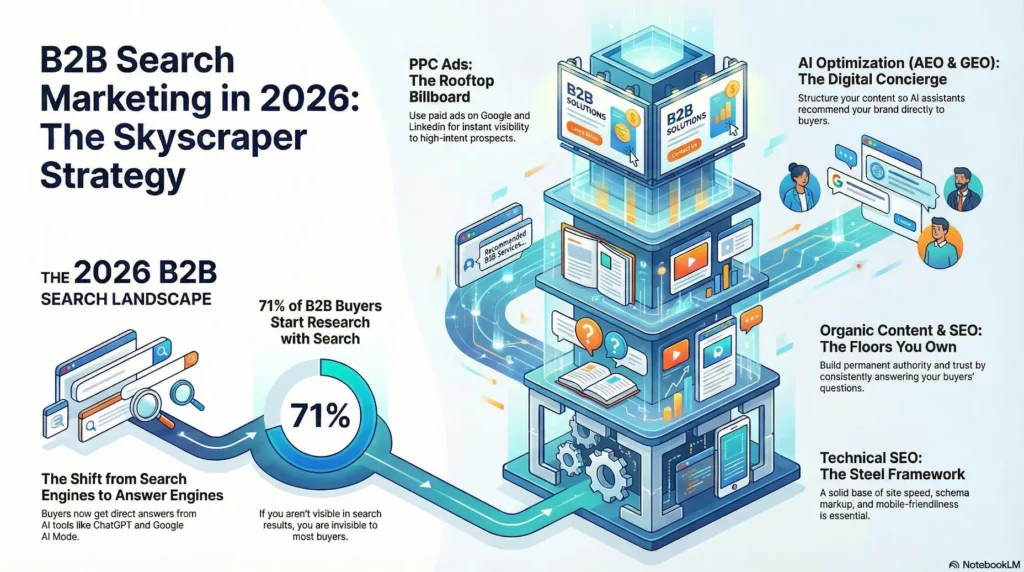
71% of B2B buyers start their research through search engines.
If your brand isn’t showing up early, you’re invisible before the first email, the first call, or the first demo.
The Shift in 2026
Traditional search isn’t enough anymore. Buyers aren’t just Googling, they’re asking AI-powered engines like:
- Google AI Mode
- Perplexity
- ChatGPT
These tools synthesize content, rank responses, and shape shortlists before anyone clicks your website.
Being “search-savvy” isn’t enough. You need to be market-visible across AI and traditional search, controlling your narrative and your pipeline.
The Mission
Your goal: move beyond traffic.
- Integrate SEO, PPC, and AI-driven optimization
- Ensure your brand appears at the exact moment a prospect asks a question
- Build authority that lasts, while capturing immediate opportunities
Think of it like a skyscraper:
- Technical SEO: The steel framework hidden under the hood
- Organic Content & SEO: Floors and offices you permanently own
- PPC: The billboard on top, visible instantly
- AI & AEO: The digital concierges guiding buyers directly to the right room
Miss one layer, and the building isn’t complete.
Miss all, and buyers never even see your lobby.
B2B Search Marketing: The SEO & PPC Playbook
If you want B2B leads in 2026, you can’t rely on just one channel.
The smartest brands combine SEO + PPC to capture buyers at every stage of their journey.
Defining the Strategy
B2B SEM isn’t about clicks. It’s about connecting with companies actively searching for solutions.
Use platforms like:
- Google – search intent goldmine
- Bing – often overlooked, high ROI
- Yahoo – niche audiences still exist
The goal: meet prospects exactly when they’re researching your solution, not after the fact.
The Pillars of Success
1. Search Engine Optimization (SEO)
SEO is your long-term foundation. It builds authority and earns organic reach.
Focus on:
- Technical health (site speed, schema, no broken links)
- Topical content authority (deep, valuable articles)
- On-page optimization (keywords, meta tags, headers)
- Off-page signals (high-authority backlinks)
SEO ensures your brand owns floors of the skyscraper, visible permanently to buyers.
Explore simple SEO tips to improve your website ranking → Read More.
2. Pay-Per-Click (PPC)
PPC is your instant visibility tool.
Use paid ads to:
- Capture high-intent prospects immediately
- Test messaging and keywords before organic results catch up
- Drive leads into your funnel fast
Platforms to prioritize:
- Google Ads (search & display)
- Bing Ads (often cheaper, high-intent users)
- LinkedIn Ads (direct B2B targeting)
The Integrated Approach
The magic happens when SEO + PPC work together:
- Immediate wins: PPC gets your brand in front of buyers now
- Long-term growth: SEO builds authority that compounds over time
- Data synergy: Paid campaigns reveal high-intent keywords for organic content
Result: You dominate search from the first impression to long-term market authority.
Find out if adding more images can boost your SEO → Read Here.
Under the Bonnet: Technical and Content SEO
If SEO is your building’s foundation, this is where you make sure it doesn’t collapse.
Technical health and high-value content are what allow your B2B skyscraper to stand tall and attract buyers.
1. Strategic Technical Health
Technical SEO is the hidden steel framework. Without it, even the best content fails.
Key moves:
- Fix Bad Backlinks: Remove or disavow links from spammy domains.
- Optimize Meta Tags: Titles, descriptions, and headers tell search engines exactly what your page is about.
- Schema Markup: Organization, Product, and FAQ schema help search engines, and AI assistants, understand your content instantly.
- Site Speed & Mobile Optimization: Fast-loading pages keep prospects engaged and improve rankings.
Think of it as making sure your skyscraper isn’t swaying in the wind.
2. Topical Authority
Content is your floors and offices, the parts buyers actually interact with.
- Be Relevant: Answer the questions your buyers are asking.
- Be Informative: Provide actionable insights that solve real problems.
- Be Consistent: Cover your industry topics comprehensively to become a go-to authority.
The deeper your content, the more floors your skyscraper has, and the more buyers trust you.
3. The Keyword Secret
Keyword strategy in 2026 is more than just short phrases.
- Target long-tail and multi-intent phrases that mirror buyer searches
- Analyze competitor terms and gaps
- Map keywords to specific content pieces, not just homepages
Pro tip: Use keywords in titles, headers, meta, and naturally within content. Overstuffing is a ranking killer.
4. On-Page vs Off-Page Balance
SEO isn’t just on your site. It’s also who links to you.
- On-Page: Optimize content structure, headings, internal links, and media
- Off-Page: Build backlinks from authoritative, relevant domains (think industry blogs, publications, partner sites)
Together, on-page and off-page SEO signal authority, boosting both rankings and trust with buyers.
See how content marketing builds brand authority → Read Here.
High-Precision PPC: Dominating Paid Channels
If SEO builds your floors, PPC is the rooftop billboard; instant visibility for your B2B brand. Done right, it drives high-intent traffic and fast pipeline growth.
1. Google & Bing Ads: Precision Targeting
Paid search is still the king of intent-driven leads.
- Choose high-intent keywords buyers actually type when ready to purchase
- Write compelling ad copy that speaks directly to business challenges
- Optimize landing pages to match ad messaging and maximize conversions
Pro tip: Test multiple variations of headlines and CTAs. Even small tweaks can boost conversion rates by double digits.
2. The Multi-Channel Funnel
B2B buyers don’t stick to one platform. Reach them where they engage:
- LinkedIn:
- Messenger Ads for direct outreach
- Sales Navigator for hyper-targeted lead engagement
- Messenger Ads for direct outreach
- Facebook & Instagram:
- Build brand awareness
- Warm up leads before retargeting with LinkedIn or Google
- Build brand awareness
- Remarketing:
- Serve ads to visitors who engaged but didn’t convert
- Keep your brand top-of-mind across multiple touchpoints
- Serve ads to visitors who engaged but didn’t convert
3. Management Essentials
Paid campaigns only work if they’re actively optimized:
- Bid Management: Allocate budget to top-performing keywords and audiences
- Landing Page Optimization: Ensure fast, relevant, conversion-focused pages
- Performance Tracking: Monitor CTR, CPC, quality score, and conversions to iterate quickly
Pro Tip: PPC + SEO = Maximum Impact
- Use PPC to test high-value keywords before committing to organic content
- Feed insights from paid campaigns into SEO strategy
- Combine both for instant visibility and long-term authority
This is how top B2B brands capture buyers immediately while building a permanent search presence.
The Future: AI, AEO, and GEO
B2B SEM in 2026 isn’t just search and ads anymore. AI is rewriting the rules, and brands that ignore it risk invisibility.
Think of AI as the digital concierge: it doesn’t wait for buyers to search, it delivers answers directly, influencing shortlists and purchase decisions.
1. Answer Engine Optimization (AEO)
AEO is about structuring content for direct answers in AI search results and voice assistants:
- Format content in clear Q&A style
- Include concise, fact-based responses that AI can surface instantly
- Use schema markup to ensure AI understands context
Pro tip: If your content answers questions better than competitors, AI recommends you first, not just ranks you traditionally.
2. Generative Engine Optimization (GEO)
Generative AI models synthesize info from multiple sources to form recommendations. GEO ensures your brand is included in those AI-generated outputs.
Focus on:
- Consistent brand mentions across authoritative sites
- Structured content (FAQ, Product, Organization schema)
- Monitoring for AI hallucinations, incorrect or outdated info
Without GEO, AI might misrepresent or omit your brand, costing leads before they even click your site.
3. Adapting to Search Decline
Traditional keyword volume is shifting toward AI-driven discovery:
- Buyers rely on AI summaries rather than multiple SERPs
- Your content must be digestible, factual, and authoritative
- Optimize for intent-based prompts, not just keywords
In 2026, visibility is about being seen where decisions are made, not just where searches happen.
Advanced 2026 Strategies: Personalization & Automation
By 2026, B2B SEM isn’t just about being found, it’s about connecting, converting, and scaling. Personalization and automation separate the leaders from the rest.
1. Hyper-Personalization
Generic messages are dead. Tailor content and campaigns to individual business goals:
- Segment audiences by industry, company size, and role
- Personalize landing pages and ad copy for specific pain points
- Deliver dynamic content based on buyer journey stage
Result: Higher engagement, faster pipeline conversion, more qualified leads.
2. Storytelling That Converts
B2B buyers are humans first. Narrative-driven content builds trust and recall:
- Share case studies and success stories to humanize your brand
- Use problem → solution frameworks to help buyers visualize results
- Leverage short, visual stories across LinkedIn, YouTube, and podcasts
Pro Tip: Storytelling makes your brand memorable and persuasive, even in complex B2B decisions.
3. Streamline with Automation
Automation frees your team to focus on high-value tasks:
- Lead qualification and scoring
- Personalized drip campaigns
- Retargeting across platforms
Tools: CRM workflows, AI-powered ad platforms, marketing automation suites.
Outcome: Less manual work, faster follow-ups, and better pipeline management.
4. Value-Add Channels
Paid search and SEO alone aren’t enough. Expand your reach and authority:
- YouTube: Tutorials, demos, thought leadership
- Podcasts: Position your brand as a category expert
- Webinars: Educate and nurture buyers directly
Bottom line: These channels reinforce visibility, trust, and engagement throughout the buyer journey.
Measuring ROI: The Marketing Efficiency Ratio (MER)
B2B SEM isn’t just about clicks or impressions.
It’s about profitability and impact. In 2026, the smartest marketers focus on real revenue, not vanity metrics.
What is MER?
MER = Marketing Efficiency Ratio
It measures how much revenue you generate for every dollar spent on search marketing.
- A high MER means your campaigns are profitable and efficient.
- A low MER signals wasted spend or misaligned targeting.
Key Metrics to Track
1. Visibility & Brand Recognition
- Are buyers seeing your brand first in search results or AI recommendations?
- Track impressions, AI Share of Voice (SoV), and SERP positioning.
2. Inbound Organic Traffic
- Measure unpaid traffic growth from SEO and content marketing.
- Segment by industry, persona, and intent for deeper insights.
3. Conversion Growth
- Focus on meaningful actions, not just clicks.
- Examples: form fills, demo requests, trials, or purchases
- Track conversion rate by channel and campaign to identify ROI.
4. Cost Efficiency
- Compare paid spend vs. revenue generated
- Optimize bids, targeting, and landing pages for maximum ROI
Pro Tip: MER + AI Insights
Use AI-driven platforms to:
- Detect which keywords or prompts drive the most conversions
- Identify underperforming campaigns fast
- Adjust messaging for hyper-targeted personalization
Bottom line: Measuring MER keeps your SEM strategy lean, efficient, and revenue-focused, while preparing your brand for AI-driven search in 2026.
Conclusion: Joining the Dots
B2B search marketing in 2026 is complex. SEO, PPC, AI, AEO, GEO, personalization, and automation all matter, but only if they work together.
Visibility wins deals. Brands dominating search and AI recommendations capture buyers before competitors even enter the conversation.
Integration drives pipeline. SEO + PPC + AI = predictable, multi-channel growth.
Data guides decisions. Track MER and KPIs to identify gaps and optimize fast.
Audit your presence across organic, paid, and AI channels. Optimize for AI and search with schema, authoritative content, and campaigns aligned to buyer intent. Automate and personalize to target the right prospects while freeing your team for high-value work. Measure results, iterate, and close gaps continuously.
Think of your B2B marketing like a skyscraper:
- Technical SEO = foundation
- Content & Organic SEO = floors you own
- PPC = rooftop billboard
- AI / AEO / GEO = concierge guiding buyers
Miss one layer, and you leave leads on the table. Nail them all, and you dominate your market in 2026.